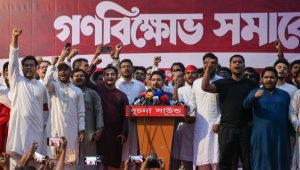



An 11-party alliance led by Jamaat-e-Islami has directed its leaders and activists not to deliver any provocative speeches during its Dhaka-Kushtia long march demanding seven points, including the implementation of the referendum verdict.
Participants have also been advised to maintain maximum caution, patience, and restraint should any untoward situation arise along the route. The motorcade is scheduled to set off at 8am Saturday, following a rally at 7am at the South Gate of Baitul Mukarram in Dhaka.
The long march will travel via the Dhaka-Mawa road, Bhanga, Gopalganj, and Faridpur to reach Khulna, before proceeding through Jessore and Jhenaidah to conclude at the Kushtia District Stadium.
Guidelines on discipline, public apology
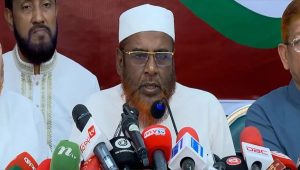
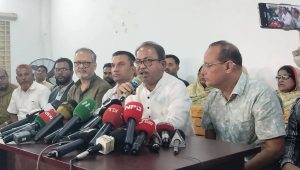
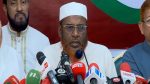
Addressing a press conference on Friday, Mia Golam Porwar, secretary general of Jamaat-e-Islami, the leading party of the coalition, issued strict guidelines to activists regarding discipline during the programme.
He urged participants to maintain order, refrain from uttering provocative slogans or speeches, and remain inside their vehicles with composure even if unpleasant incidents occur along the way.
The alliance leader also offered an advance apology and expressed regret for any temporary inconvenience the long march might cause to businessmen, general pedestrians, shopkeepers, and small traders, observing that the public has historically made significant sacrifices and endured hardships during movements to realise democratic rights.

Opposition demands and past marches
This marks the third long march conducted by the parliamentary opposition coalition. Previously, the alliance held long marches from Dhaka to Chattogram on 5 September and from Dhaka to Rangpur on 19 September.
The coalition initially pressed six demands – the implementation of the referendum verdict, the trial of the July genocide, the resolution of energy and agricultural crises, the control of essential commodity prices, the improvement of law and order, and an end to the politicisation of the administration.
They subsequently added a seventh demand calling for an end to corruption, extortion, and land-grabbing, while also warning of a one-point movement to overthrow the government.
Dispute over referendum verdict, governance
Discussing the national political situation, Porwar alleged that the government is creating a political crisis by denying the verdict of the referendum, emphasising that the issue must be resolved in parliament.
During the national election under the interim government on 12 February, a referendum was held on the July Charter, where 68 per cent of voters voted “Yes.”
However, the BNP now maintains that while it accepted the referendum for the sake of holding the election, the vote was unconstitutional.
Porwar pointed out that even the prime minister had campaigned for a ‘Yes’ vote, noting that from the issuance of the referendum ordinance until the election and government formation, the BNP had never called it unconstitutional.
He criticised the ruling party for questioning the verdict after assuming power, saying that enjoying one vote to become the prime minister and MP while denying another is inconsistent.
The secretary general noted that the parliamentary session will resume on 9 November and suggested that if the government is sincere, it can convene a session of the Constitution Reform Council to resolve the matter in parliament, where the opposition is ready to cooperate.
He warned that failure to implement the referendum verdict could further deepen the political crisis, accusing the government of adopting a one-party, authoritarian attitude that is pushing the country towards conflict.
Moreover, Porwar blamed the government for deteriorating law and order, claiming that nearly 200 killings have occurred due to internal feuds within the BNP.

He also cited widespread politicisation across the Secretariat, district administration, the Election Commission, educational institutions, and the judiciary, highlighting that keeping public institutions neutral had been an electoral pledge of the BNP.
Additionally, he alleged that extortion continues at markets, ghats, sand quarries, tempo stands, and rickshaw stands, where only the party names, signboards, and individuals have changed while the same practices continue.
By-election rigging allegations
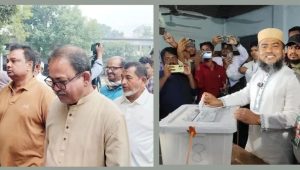
In a separate development, the 11-party alliance brought allegations of electoral rigging regarding Thursday’s Thakurgaon-1 constituency by-election.
Porwar claimed that presiding and polling officers performed duties without identity cards or badges, opposition agents were expelled, proxy votes were cast, and attempts were made to seize ballot boxes prior to the announcement of results.
Stating that comprehensive information on these allegations has been compiled, he added that the party position regarding the results will be announced after analysing and reviewing field-level data.
In the by-election for the seat vacated after Mirza Fakhrul Islam Alamgir became the president, Jamaat-e-Islami failed to put up a strong contest, with its candidate losing to the BNP candidate by a margin of 131,404 votes.