Military units loyal to the internationally recognised administration of Yemen have launched a major counter-offensive targeting Houthi fighters, with leadership announcing a campaign to recapture the capital city, Sanaa, from the Iran-aligned rebel group.
This development represents the sharpest escalation in hostilities since a United Nations-mediated ceasefire paused widespread conflict in 2022, reports Al Jazeera.
The military decision to regain control of Sanaa was confirmed by Major-General Samir Al-Sabri, Yemen’s Deputy Defence Minister, during a broadcast on national television.
Majid al-Nuzaili, representing the government-aligned military forces, explained that the operation aims to free the nation from Houthi control and re-establish Sanaa as a shared capital for all citizens.
To protect civilians, al-Nuzaili advised against using key arterial roads that connect Sanaa to Marib and al-Jawf, specifying the routes traversing Sirwah, Nihm, Mahliyah, and al-Hazm.
Broadening battlefronts
The conflict has intensified across several provinces, including Taiz, al-Bayda, and al-Jawf, with the latter serving as the primary corridor to the capital.

Ahmed al-Shalafi, Al Jazeera’s Yemen affairs editor, noted that government forces have managed to withstand the initial momentum of the recent rebel push and have broadened the combat zone across multiple fronts to disperse and pressure Houthi troops.
Although the initial clashes on Thursday were limited to areas west of Taiz and south of Hodeidah, they have since expanded into al-Dhalea, Marib, al-Bayda, and al-Jawf.
Al-Jawf holds immense tactical value as it borders Saudi Arabia and links directly to Saada, the main Houthi stronghold, while the central province of al-Bayda serves as a critical geographic hub connecting eight northern and southern governorates.
Root causes and geopolitical tensions
The civil conflict began in 2014 when Houthi forces seized Sanaa, which subsequently triggered a military intervention by a Saudi-led coalition in 2015.



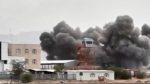
Although international mediators hoped the 2022 truce would lead to a permanent peace agreement, regional friction stemming from the war involving the United States, Israel, and Iran has derailed these diplomatic efforts.
Hostilities flared up again in July after government forces launched strikes on Sanaa’s airport to block an incoming flight from Iran. Last week, Houthi rebels launched a major offensive in western Taiz and southern Hodeidah, attempting to push toward the port of al-Makha and the strategic Bab al-Mandeb Strait.
The Houthis subsequently declared a blockade against Saudi-flagged ships navigating the Bab al-Mandeb Strait, a vital shipping lane connecting the Red Sea with the Gulf of Aden.
This waterway has grown increasingly critical for Saudi oil transport because Iran has restricted access through the Strait of Hormuz since the beginning of the US-Israel conflict with Tehran.
Opposing combat claims
Rashad al-Alimi, the head of the Saudi-supported Presidential Leadership Council, claimed on Monday that government forces had achieved widespread progress in Taiz, Hodeidah, al-Jawf, and al-Bayda.
He asserted that the government would continue its constitutional duties until state control is restored over all Yemeni territory, and he blamed the Houthis for choosing escalation over peace.
According to the government’s military media arm, pro-government forces carried out several air strikes against Houthi targets west of Taiz late on Monday.
Additionally, they launched a ground campaign toward the al-Labanat mountains in al-Jawf, conducted rocket strikes on Yatma, and progressed to the edges of the Dhi Na’im district in al-Bayda.
In contrast, Houthi representatives claimed they successfully repelled the pro-government assault on the al-Labanat mountains. Mohammed al-Farah, a member of the Houthi political bureau, stated on the social media platform X that dozens of government troops were killed or injured, and that Houthi ballistic missiles struck military reinforcements in al-Jawf, disabling dozens of military vehicles.
The rebel group also broadcast video footage showing what they described as a ballistic missile strike targeting trucks carrying Saudi military supplies at the al-Wadiah camp in southeastern Hadramawt, which Riyadh did not comment on.
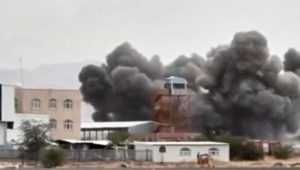
Houthi officials accused Saudi Arabia of launching an air strike on a detention facility in the al-Jawf town of al-Hazm, which they reported killed seven people. Meanwhile, Riyadh accused the Houthis of wounding at least 73 civilians, including women and children, in attacks targeting the southern provinces of Saudi Arabia, and vowed to retaliate against this dangerous escalation.
Heavy casualties and displacement
The resurgence of fighting has exacted a severe toll on the civilian population. The World Health Organization reported on Monday that at least 728 people have been killed or wounded since 23 August, with the heaviest casualties recorded in Taiz and along the western coast.
Approximately 21,000 people (around 3,000 families) have been forced to flee their homes in Taiz since Thursday.
Yousef Mawry, reporting for Al Jazeera from Sanaa, indicated that the casualty figures are expected to climb, as they do not yet reflect Monday’s intense fighting, which reportedly included heavy air strikes in al-Jawf.
Al Jazeera noted that it was unable to independently verify the military claims made by either side.