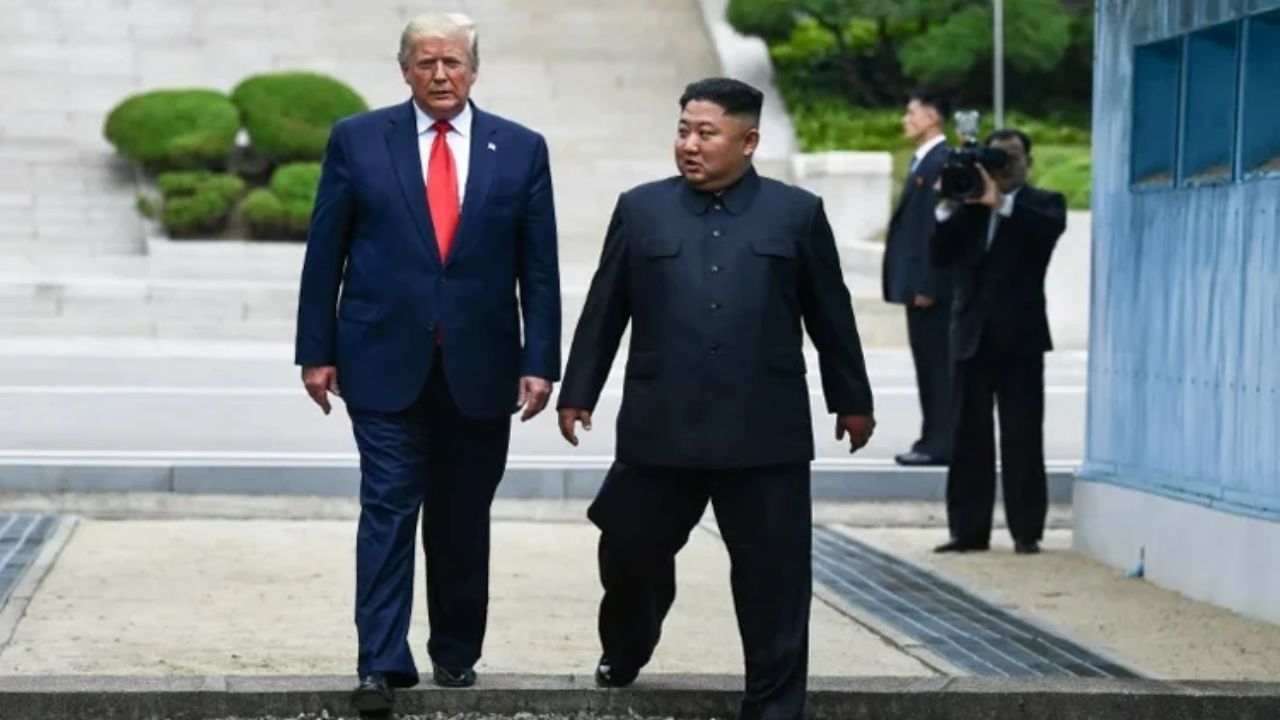



US President Donald Trump has claimed that North Korean leader Kim Jong Un has responded to his recent diplomatic outreach, a day after Trump ordered the Pentagon to substantially reduce joint military exercises with South Korea, a longstanding US ally in Asia.
Asked by reporters in the Oval Office on Monday about the lack of a response from Pyongyang, Trump said, “How do you know he hasn’t responded?”
When pressed on whether Kim had made contact, Trump confirmed: “Yeah, he has.” Trump described the exchange as “very positive” but declined to provide further details, reports Aljazeera.
North Korea has not immediately commented on the matter.
Drill reductions and dispute over Iran
On Sunday, Trump instructed the Pentagon to “substantially reduce” annual joint military exercises with South Korea.
In a post on his Truth Social platform, Trump criticised the drills, saying they were “not only costly … but send a signal that is totally inappropriate and hostile, to a Country that, as long as Donald J. Trump has been President, has been unthreatening and respectful”.

Trump also explicitly linked the reduction of the exercises to Seoul’s refusal to assist with the US-led war on Iran.
On Monday, he intensified his criticism of South Korea’s position at the Oval Office.
“Wait a minute,” Trump said. “We have 39,000 soldiers over there, guarding you from Kim Jong Un, your next-door neighbour, and you’re not going to help us on a very easy military operation in Iran. That’s strange.”
Trump also questioned continued US support for South Korea and NATO allies that have declined to contribute to the war effort in Iran.



“We can’t go around and protect all of these countries, especially when they’re not there to help us,” he warned.
Seoul defends exercises
South Korean officials confirmed that the military exercises had begun as scheduled and expressed hope that the personal relationship between Trump and Kim could help revive diplomatic negotiations.
On Tuesday, Seoul’s presidential office clarified that the joint drills did not reflect “any intention to attack North Korea or escalate tensions on the Korean peninsula”.
South Korean President Lee Jae Myung reiterated that the fundamental purpose of the annual drills is “not to treat a specific entity as an adversary, but to safeguard the safe and peaceful daily lives of the people”.
History of direct diplomacy and regional shifts
Although Trump’s relationship with Kim has received less attention from the White House than during his first term, the US president has repeatedly signalled an interest in reviving direct diplomacy.
Negotiations between the two leaders broke down in 2019 over Pyongyang’s nuclear weapons arsenal.
Last year, Kim’s sister, Kim Yo Jong, acknowledged that the personal relationship between the two leaders was “not bad”. However, she warned that any US attempt to use that relationship to dismantle North Korea’s nuclear weapons programme would be met with “mockery”.
Since the 2019 Hanoi summit, North Korea has significantly strengthened its strategic ties with Russia while maintaining close relations with China.
North Korean troops have reportedly fought alongside Russian forces in the invasion of Ukraine. Kyiv officials also claimed last week that North Korean-made missiles were used in a Russian ballistic missile strike against a steel plant in Zaporizhzhia.
Despite repeated criticism from the Trump administration over North Korea’s military assistance to Russia, Trump on Monday praised Kim, saying, “Kim Jong Un has always treated me with great respect.”
He added, “I understand him. He understands me.”
Analysts sceptical about swift response
Some analysts believe another meeting between the two leaders remains possible despite North Korea’s cool response to Trump’s recent overtures and Kim’s strengthened geopolitical position since 2019.
However, Victor Cha, head of the Korea programme at Washington’s Center for Strategic and International Studies (CSIS) think tank, expressed doubt that Pyongyang would respond swiftly.
“I think they’re going to bide their time and wait a little bit,” Cha told Reuters.
Cha also suggested that Trump’s decision to raise the North Korean issue at this point was partly aimed at diverting media attention from his ongoing political struggles over the war in Iran, although the president remains genuinely interested in meeting Kim again.