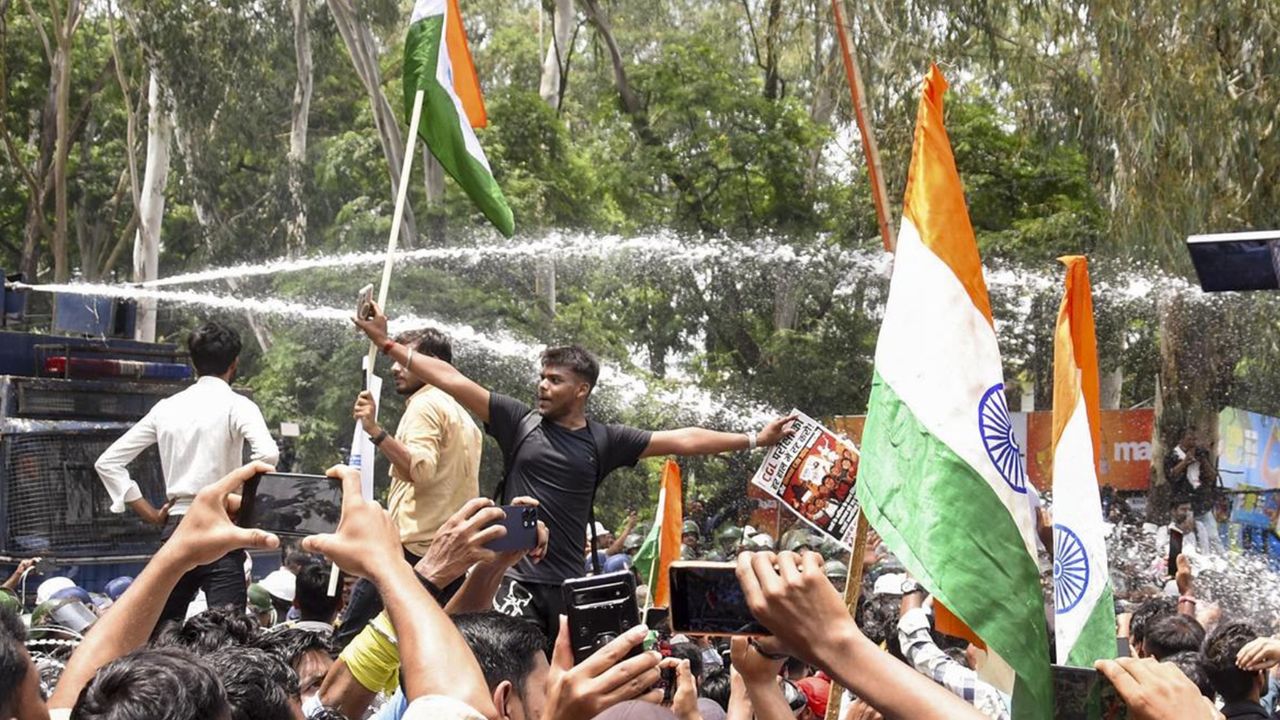



Students marched towards Jharkhand’s Legislative Assembly in Ranchi on Monday, prompting riot police to deploy water cannon and barricades, as protests over alleged irregularities in state government recruitment examinations entered a new phase.
The demonstration is the latest in a wave of unrest that began in late July over claims of malpractice in exams run by the Jharkhand Public Service Commission (JPSC), including allegations that test papers were leaked before sittings, reports Al Jazeera.
Protesters are calling for a complete overhaul of the state’s examination system, the scrapping of certain tests, and a federal police investigation into the alleged leaks.
Hundreds of officers guarded the assembly building behind multiple layers of barbed-wire barricades, with surveillance drones deployed overhead, after several rounds of negotiations between student representatives and the state government failed to produce a resolution.
Security forces used water cannon after demonstrators attempted to scale barricades near the Jagannath Mandir temple, roughly three kilometres from the assembly complex.

Among those on the front line was student leader Devendra Nath Mahto, who joined Monday’s march on a stretcher after nine days without food.
He is one of at least six protesters currently on indefinite hunger strike. Addressing the crowd in remarks broadcast by Indian media, Mahto said barbed wire would not deter the demonstrators despite the hunger strike.



Late on Sunday, the state government agreed to cancel the 14th JPSC preliminary examination along with two backlog recruitment tests, while three JPSC board members resigned after being questioned by state investigators.
Student groups have said, however, that they will keep protesting until authorities also cancel the Combined Graduate Level examination and transfer the leak investigation to the Central Bureau of Investigation, arguing the state’s own inquiry has been inadequate.
The unrest has deep roots. Anger over alleged malpractice first flared last September, when thousands of candidates gathered outside the Jharkhand Staff Selection Commission (JSSC) office alleging irregularities in the
Jharkhand General Graduate Level Combined Competitive Examination, sat by more than 300,000 candidates across over 800 centres. Authorities had suspended mobile internet during the exam sittings to try to prevent cheating. A three-member panel was later set up to probe the claims.
Tensions resurfaced in December, when police baton-charged candidates protesting near the JSSC office during document verification for that same exam, briefly detaining Mahto, who leads the Jharkhand State Students’ Union.
The current agitation, staged at Ranchi’s Jaipal Singh Munda Stadium before Monday’s assembly march, has also exposed divisions among protest organisers.
The movement has splintered into rival camps, with Mahto’s Jharkhand Loktantrik Krantikari Morcha and a separate students’ coalition, the JPSC-JSSC Reform Manch, disagreeing over tactics and leadership even as both continue pressing the government for a judicial inquiry led by retired High Court judges from outside the state.
Organisers say the protest is being run without political funding, with food and shelter provided voluntarily by local temples and community groups.
The demonstrations echo a youth-led movement that unfolded in New Delhi weeks earlier, when a campaign known as the Cockroach Janta Party sustained 36 days of protests over leaks in the national medical school entrance test.
That agitation forced the resignation of federal Education Minister Dharmendra Pradhan. Jharkhand’s protesters have pointed to that outcome as evidence that sustained pressure can force concessions from authorities, even as the state government insists it is acting to address the allegations through resignations and exam cancellations.