
He was eight years old when he fell in love with football. Not at a stadium. Not with a ticket in his hand. He fell in love on a Tuesday night in Dhaka, pressed between his father and three cousins on a narrow cot, watching a fuzzy television screen beam the World Cup into their small apartment in Mirpur. He does not remember who scored. He remembers the noise: his father’s sudden shout, the neighbours banging on the wall from the other side, the street below erupting in horns. He remembers thinking: this is the greatest thing in the world, and somehow, impossibly, it belongs to all of us.
He was right, then. He is not right anymore.
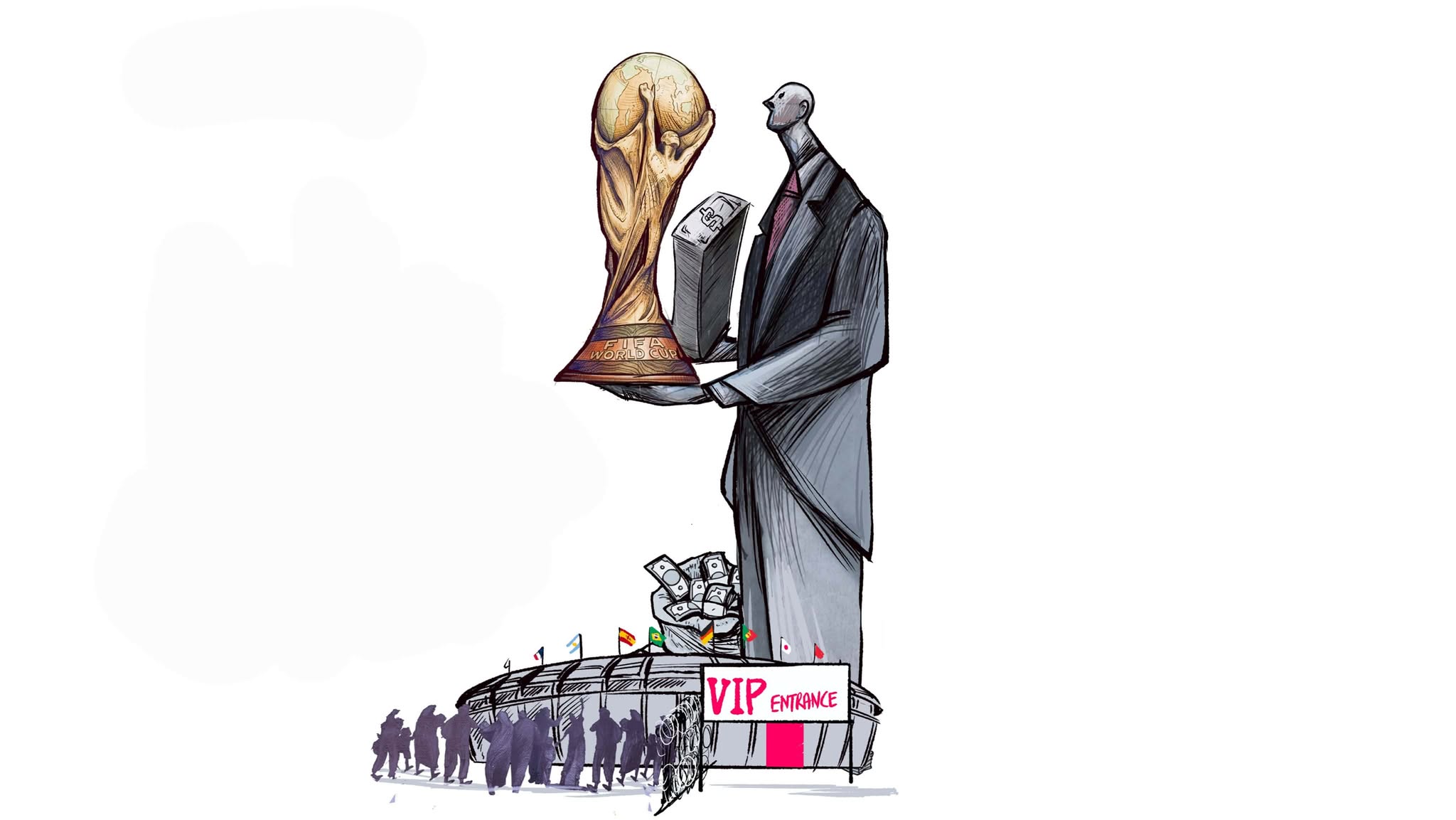
The 2026 FIFA World Cup, which kicks off on June 11 across the United States, Canada and Mexico, is being sold to us as the grandest sporting event in human history. FIFA President Gianni Infantino calls it the equivalent of “104 Super Bowls.” Forty-eight teams. One hundred and four matches. Six billion viewers. The most inclusive World Cup ever, he has promised. And yet, from the streets of Dhaka to the living rooms of Delhi to the fan clubs of Dakar and Abidjan, the tournament’s arrival has provoked not anticipation, but a creeping, well-documented dread. Because the numbers, when you look at them honestly, tell a different story entirely. They tell the story of a tournament that has quietly, deliberately, and perhaps irreversibly transformed itself from a global people’s festival into a luxury product and left the world’s ordinary football fans outside in the rain.
The Ticket That Became a Dream
Let us begin with the most basic thing: getting in.
When the North American bid was made, Football Supporters Europe noted that FIFA had initially promised tickets would be available from as little as $21, roughly 2,560 taka. Instead, the cheapest tickets to go on sale were priced at $60, limited and allocated to only a small portion of venues, introduced after immediate backlash over the original pricing. That backlash was entirely justified. When tickets first went on sale in December, prices ranged from $140 for Category 3 seats to $8,680 for the final. The USA’s opening match against Paraguay was priced at $1,120, $1,940, and $2,735, and this was described as only the third most expensive match of the tournament.
It has gotten worse since then. The most expensive group-stage ticket currently listed is for the United States’ opening match in Los Angeles, priced at $4,105, over five lakh taka. The cheapest available seats are $380 for matches such as Curacao vs. Ivory Coast. And for the final? The World Cup final at MetLife Stadium in New Jersey on July 19 costs nearly $33,000, more than 40 lakh taka, for a single seat.

For the first time, many fans are openly saying that the World Cup is moving away from ordinary supporters and turning into a premium sports product aimed primarily at corporations, VIP guests and wealthy travellers. The trajectory is impossible to deny. At the 2014 World Cup in Brazil, the best seats for the final cost no more than around $1,000. In 2018 in Russia, premium seats surpassed $1,100. Qatar was the first clear sign FIFA was changing its philosophy. But 2026 appears to take that transformation to an entirely new level.
FIFA’s defence? Infantino has defended high ticket prices, saying the event is the organisation’s only source of income every four years, reiterating that FIFA is a nonprofit organisation that has 211 member nations who are supported through the revenue FIFA generates. A nonprofit, incidentally, whose president travels by private jet. The logic that the world’s fans must pay over five lakh taka for a group-stage seat so that FIFA can fund football development is the kind of circular reasoning that would embarrass a first-year economics student.
Getting There: The Hidden Second Bill
If you somehow managed to buy a ticket, your financial ordeal is only beginning. The infrastructure of travel has been priced at the same altitude as the tickets themselves.




In Boston, the hourlong train to Gillette Stadium will cost $80 this summer, nearly 9,800 taka for a single journey, four times the cost of the same journey for New England Patriots games. An express bus will cost $95. NJ Transit, which originally had a round-trip ticket package from New York City to MetLife Stadium for $150, lowered it to $105 following public backlash, when a normal ride on the same route costs just $13.
Accommodation follows the same logic. A two-night Airbnb stay near Gillette Stadium averaged $3,044, roughly 3.7 lakh taka, the highest lodging total in a study of all US host cities, while the median resale ticket price for Scotland vs. Morocco reached $4,986. A fan from Buenos Aires put it plainly to ESPN: “The travel distances are very long. And, when you add stadium prices, food, hotels and everything else, I think it really discourages Argentinians who are not, obviously, upper class.”
The England Supporters Travel Club has estimated that a fan following England to the final could need more than $7,000, over 8.5 lakh taka, for tickets and basic expenses alone, not including airfare and accommodation. For a fan from Bangladesh, where the average monthly income sits below 25,000 taka, this figure is not merely expensive. It is a different planet.
The Political Wall
Then there is the matter of actually being allowed in.
The United States under President Donald Trump is not the open, welcoming host that football deserves. As of January 2026, the Trump administration had fully restricted the entry of nationals from 19 countries, including Haiti, Iran, Somalia, Sudan, and Syria. Partial restrictions exist for nationals from 20 additional countries, including Ivory Coast, Senegal, Nigeria, and Cuba. Two teams competing in the World Cup, Iran and Haiti, are subject to bans on all immigrant and non-immigrant visas. Two others, Ivory Coast and Senegal, face partial bans. The players can enter. Their fans cannot.
For months, citizens of 50 countries faced an additional burden: visa applicants were required to pay bonds of $5,000, $10,000, or $15,000 to obtain a temporary US visa, between 6 lakh and 18 lakh taka, money that would be refunded only if the traveller complied with visa terms or was denied. The bond requirement was only partially waived, just days ago, for ticket holders from five qualifying nations who had registered with the FIFA Pass system by April 15. The last-minute timing is itself an indictment. Millions of fans had already made their decisions. The American Hotel and Lodging Association blamed visa barriers and geopolitical issues for “significantly suppressing international demand,” leading to hotel bookings far below what had initially been anticipated.
The ACLU and Amnesty International, alongside more than 120 civil society organisations, issued a formal travel advisory warning of the “deteriorating human rights situation” in the United States, citing increased surveillance, violent immigration enforcement, the possibility of detention or deportation, and invasive social media screening for visitors. The White House dismissed it as “ridiculous scare tactics.” The fans it was written for know better.
The Blackout: Billions Shut Out at Home
Perhaps the cruelest irony of all is this: even those fans who cannot afford to travel, who accepted long ago that they would watch their World Cup from a sofa or a street corner or a tea stall television, even they may be denied.
The FIFA World Cup 2026 is set to begin in just 33 days, but there is a strong possibility that Bangladeshi viewers may face a World Cup blackout, as no broadcaster in the country has secured telecast rights. The reason is staggering: a Singapore-based company called Springbok Pte Ltd, which secured media rights for Bangladesh from FIFA, is demanding $12.30 million, approximately 151 crore taka, from state broadcaster BTV, with 50 percent due by May 10. Including taxes and VAT, that figure climbs toward 200 crore taka. Four years ago, all 64 matches of Qatar 2022 aired freely in Bangladesh. This year, that same nation of passionate football supporters may watch nothing at all.
Bangladesh is not alone. As of May 2026, no Indian broadcaster has secured rights to the tournament, an extraordinary situation for one of the world’s largest and fastest-growing football markets. India contributed 32 million digital viewers for the 2022 World Cup final alone. A Reliance-Disney joint venture offered around $20 million for Indian broadcast rights, well below FIFA’s asking price, while Sony also declined to submit an offer. FIFA reportedly sought $250 to $300 million from China’s CCTV, between 300 and 365 crore taka, a figure that provoked widespread pushback, and even after reportedly lowering its price, a substantial gap between the two sides remained. China reportedly contributed nearly half of all global digital viewing hours during the 2022 World Cup. The idea that these populations, three billion people between India and China alone, may be effectively shut out of the world’s biggest sporting event while FIFA pockets billions is not a footnote. It is the story.
What Has Been Lost
The World Cup was always more than football. It was the one moment every four years when the fisherman in Kerala and the taxi driver in Casablanca and the schoolboy in Chittagong were watching the same thing, feeling the same thing, screaming at the same moment. It was the tournament that needed no translation. It crossed every border that mattered.
FIFA has now erected borders of its own, made of money, of politics, of pricing algorithms and broadcast rights negotiations conducted in Singapore boardrooms. The “most inclusive World Cup in history” has managed to exclude fans by nationality, by income, by geography, and now potentially by their country’s failure to afford a television deal. The 48-team expansion, sold as a gift to the world, has instead produced 104 matches that cost more to watch and more to attend than any tournament before it. More football for the wealthy. Less football for everyone else.
That boy from Mirpur is in his mid-twenties now. He still loves football. But this June, he may not be able to watch his World Cup on television. FIFA’s asking price made sure of that.
The child on the cot in Dhaka, pressed between his father and cousins, erupting with joy: FIFA has decided he was never really the point.