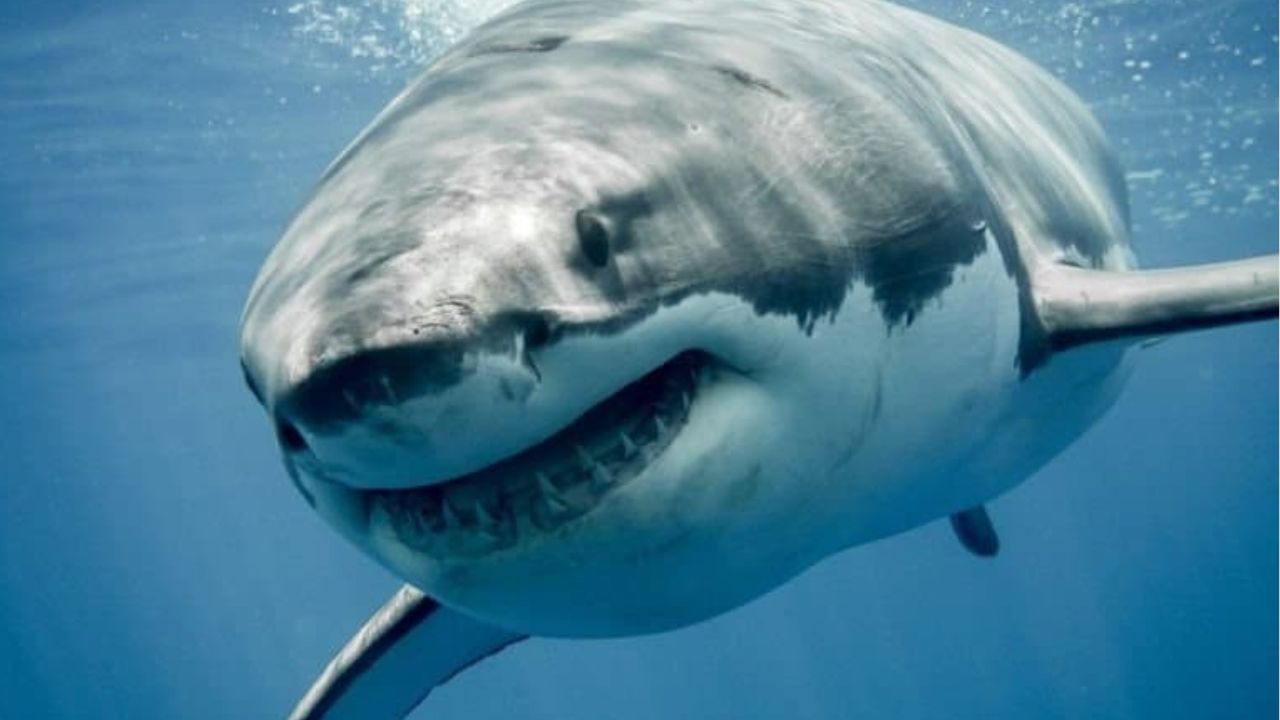



While sharks are often depicted as mindless, solitary predators, scientific research reveals they are complex creatures with surprising traits, including mathematical abilities and a preference for jazz music. After hundreds of millions of years of evolution, these elite ocean predators share more in common with humans than is often assumed.
Evolutionary survivors
Sharks are among the Earth’s original vertebrate predators and have survived all five of the planet’s major mass extinctions. This includes the “Great Dying,” or the Permian-Triassic extinction, which eradicated approximately 90 per cent of marine life.
Today, they inhabit nearly every part of the global ocean. Their lineage is exceptionally ancient; fossil evidence of shark ancestors’ dates back 450 million years, making them older than trees, dinosaurs, the rings of Saturn, and even the North Star, reports BBC.
Mathematical and social intelligence
Contrary to their “mindless” reputation, sharks have demonstrated the ability to perform basic maths, such as distinguishing between quantities like three and five. Research indicates that young grey bamboo sharks can remember information regarding shapes and optical illusions for nearly a year.

Socially, sharks are far from the lone hunters often portrayed in media. Grey reef sharks have been observed maintaining specific “cliques” of friends for up to four years.
In one notable case, two great white sharks, named Simon and Jekyll, travelled 6,000 kilometres together without separating. Young lemon sharks live in groups and learn essential survival skills, such as finding food and avoiding predators, from one another.




Unique biological traits
Sharks possess a variety of remarkable biological features. Many species, including bull sharks and hammerheads, give birth to live young fed via an umbilical cord, leaving pups with temporary “belly buttons” or umbilical scars.
Conversely, sand tiger sharks engage in “intrauterine cannibalism,” where embryos consume their siblings in the womb until only one remains.
Their skin is another marvel, covered in tiny “teeth” called denticles that reduce aerodynamic drag. Historically, this material, known as “shagreen,” was used by 18th-century Italian craftsmen to smooth Stradivarius violins and by Victorian cabinet makers.
Super-sensory capabilities
Sharks possess eight senses, including the ability to detect electrical impulses and the Earth’s magnetic field. Using pores known as the ampullae of Lorenzini, they can sense the muscle contractions of nearby animals, such as a beating heart, allowing them to hunt in total darkness. These sensors also assist in trans-oceanic navigation.
Musical preferences
In a study conducted by researchers at Macquarie University in Sydney, Port Jackson sharks demonstrated a specific taste for music. According to researcher Culum Brown, the sharks successfully associated a feeding location with jazz music but were unable to make the same connection with classical music.
Humans and sharks share a common ancestor that lived approximately 440 million years ago, suggesting that despite our divergent evolutionary paths, our existences remain intrinsically linked.