
It began with just 18 crane operators recruited from abroad.
There was no heavy equipment to its name, no substantial capital investment and little to suggest that the manpower supplier would one day become a dominant force at Bangladesh’s principal seaport.
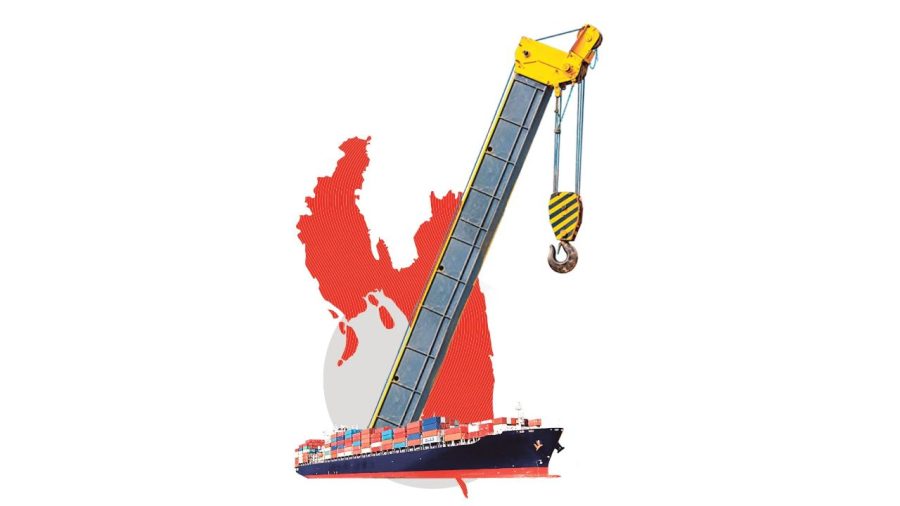
Over nearly two decades, Tarafder Md Ruhul Amin turned Saif Powertec into a port-centric business empire. At its peak, the company controlled or influenced nearly 75 per cent of operational activities at Chattogram Port.
Its footprint extended beyond Chattogram to container handling facilities in Dhaka and Pangaon. It generated annual revenue of up to Tk300 crore between 2019 and 2024 and pursued ambitious international shipping and logistics ventures with an Abu Dhabi-based port operator.
That empire has largely unravelled.
On Monday, the expiry of Saif Powertec’s contract to operate the Chattogram Container Terminal (CCT) marked the end of its direct involvement in terminal operations at Chattogram Port, following the loss of the New Mooring Container Terminal (NCT) in July last year.
Its operations at Dhaka’s Kamalapur Inland Container Depot (ICD) and Pangaon Inland Container Terminal (ICT) have also ended.
A major investment project at Mongla Port remains stalled, while several international business ventures have failed to materialise.
Building a port empire
Saif Powertec entered the port business when Akbar Hossain served as the shipping minister from 2001 to 2006 under the BNP-led government.

What began as a manpower supply business gradually expanded into berth and terminal operations at Chattogram Port from around 2007.
The company eventually secured operating contracts at the CCT and NCT, as well as at facilities in Kamalapur and Pangaon.
Saif Powertec had previously said that around 2,500 employees were engaged in its operations at the NCT and CCT alone.
But its expansion had long raised questions among industry stakeholders about the role of political and administrative connections in securing port contracts.
Critics alleged that certain tender conditions and decisions concerning the CCT, NCT and Kamalapur ICD gave Saif Powertec an advantage over its competitors.
The company has consistently rejected claims that its business depended on political patronage.



Losing its grip, one terminal at a time
The first major setback at Chattogram Port came on 7 July 2025, when responsibility for operating the NCT was transferred to Chittagong Dry Dock Limited (CDDL), an organisation managed by the Bangladesh Navy.
The expiry of its CCT contract on Monday brought an end to its long-standing presence as a terminal operator at the port.
Outside Chattogram, Saif Powertec has also lost its operating role at Pangaon ICT, which is now operated by Medlog, a subsidiary of global shipping group MSC.
Its contract with the Chattogram Port Authority (CPA) to operate the Kamalapur ICD expired in 2023. A legal dispute initiated by the company delayed the appointment of a new operator, leaving the port authority to manage cargo and container handling itself.
On Monday, the CPA issued a tender to appoint an operator for the facility for a five-year period.
CPA Secretary Syed Refayet Hamim told TIMES that the tender process had resumed after legal complications surrounding a court-ordered stay were resolved.
The authority will continue to manage the facility until a new operator is appointed.


A global ambition that never took off
Even as Saif Powertec built its domestic port business, it sought to expand into international shipping and logistics through partnerships with Abu Dhabi-based AD Ports Group.
The plans were ambitious. None of the major proposals, however, translated into the expected business operations.
On 25 September 2022, Saif Maritime LLC, a wholly owned subsidiary of Saif Powertec, signed a 15-year agreement with Safin Feeders, an affiliate of AD Ports Group.
The agreement envisaged the operation of three feeder vessels carrying 10,000 containers a month between Dubai and Bangladesh, with projected savings of $150–$200 per container.
Services were scheduled to begin in December 2022. They never started.
In June 2024, Saif Powertec signed a memorandum of understanding (MoU) with AD Ports Group to develop container depots and logistics facilities at Chattogram, Mongla and Pangaon ports.

That agreement followed a non-binding MoU signed between the CPA and AD Ports Group on 16 May 2024 concerning a proposed $1 billion investment in the Bay Terminal project. Saif Powertec acted as the Abu Dhabi group’s local representative.
The initiative went no further. According to the CPA, the MoU has expired, leaving no scope for investment under that arrangement.
A former Saif Maritime official, speaking to TIMES on condition of anonymity, said the company’s plans to purchase and operate vessels, including on routes connecting Dubai and Bangladesh, had not materialised.
Its proposed partnerships and investment initiatives with AD Ports Group had also failed to produce the anticipated results.
The official said a stronger international presence might have left the company better positioned to withstand domestic political and administrative changes.
Excessive dependence on political patronage, he added, was unsustainable for a business operating in a strategic sector such as ports.
Business capabilities or political patronage?
Saif Powertec Managing Director Tarafder Md Ruhul Amin rejected allegations that political connections were behind the company’s success.
Asked about the loss of its terminal operations, he told TIMES that he did not know why the company was losing its responsibilities at the port, adding that it was “not an issue”.
Responding earlier to allegations of political influence in securing contracts, he said Saif Powertec did not depend on any political party or government and operated on the strength of its own capabilities and performance.
“Businessmen do not engage in politics; they work with everyone. We do not conduct business by seeking political favours. Our operations are defined by our own standards and performance,” he said.
Meanwhile, the publicly listed company, which once generated up to Tk300 crore in annual revenue, has yet to disclose its business performance for periods after June 2024.
Saif Powertec’s shares once reached Tk100 following its stock market debut in 2014. They closed at Tk6.70 apiece on the Dhaka Stock Exchange on Thursday.