


Opposition Chief Whip and National Citizen Party (NCP) Convener Nahid Islam has called for a long-term roadmap to forge national unity with political and social forces aligned with the July mass uprising.
Speaking to reporters at the Secretariat after meeting Prime Minister Tarique Rahman on Monday, Nahid said the struggle to prosecute the activity-banned Awami League, counter Indian hegemony, and safeguard the country’s sovereignty and democracy cannot be confined to December alone.
He stressed the need for a long-term strategy, including a joint national foreign policy agreed upon by political parties.
Nahid said the meeting covered the country’s overall situation, deteriorating law and order, national unity, reforms, the trial of the Awami League and the Ganges water-sharing treaty.
He expressed concern over the recent deterioration in law and order, saying public safety had been compromised, affecting members of the ruling party, opposition parties, anti-fascist activists and leaders of the July mass uprising.
He also alleged that the ousted Awami League was continuing acts of terrorism and arson in different parts of the country.
Nahid said the current situation had not emerged overnight but was the result of a continuous deterioration in law and order over the seven to eight months since the election, compromises over justice, the absence of a firm government position on the Awami League and a lack of clarity in Bangladesh’s diplomatic stance towards India.
Stressing that reforms, justice and national sovereignty must form the foundation of national unity, he said the NCP had proposed incorporating institutional reforms into the unity initiative.

“If we cannot strengthen democracy, if we cannot strengthen and make our institutions sustainable, we will not be able to earn the trust of the people,” he said.
Criticising the constitution amendment committee, Nahid described it as a single-party body obstructing reforms, the public mandate expressed in the referendum and implementation of the July Charter.
The NCP proposed abolishing the committee and implementing the July Charter in accordance with the referendum verdict.
He emphasised the need to strengthen key institutions, including the Anti-Corruption Commission, Election Commission, caretaker government system, upper house of parliament and independent judiciary.
Without such institutional reforms, he argued, democracy could not be sustained, while economic stability and investment would remain difficult to achieve.



Regarding the prosecution of the Awami League, Nahid said proceedings against the party remained under investigation at the tribunal.
He urged the government to expedite the legal process, including district-level investigations and the submission of charge sheets, to ensure justice for victims of the July mass uprising.
He also called for effective government initiatives to bring Sheikh Hasina back to Bangladesh to execute the verdict against her and to repatriate the killers of Osman Hadi to face trial.
Turning to relations with India, Nahid said the Ganges water-sharing treaty would expire on 12 February and urged the government to adopt a firm negotiating position to secure Bangladesh’s fair share of water under a new agreement.
He warned that attempts were being made to destabilise Bangladesh through the Awami League, India and their domestic collaborators.


“The struggle now is not against the Awami League. We defeated the Awami League on 5 August. The fight now is against Indian hegemony,” he said.
Nahid also accused India of conducting a disinformation campaign against Bangladesh.
Referring to a rally organised by the Bharatiya Janata Party (BJP) and Hindutva organisations near the border, he alleged that false claims about the persecution of Hindus in Bangladesh had been circulated with the involvement of fugitive Awami League leaders.
To counter such activities and preserve national unity, he urged the government to engage with a broad range of social and religious groups, including Islamic scholars, followers of shrines and dargahs, cultural workers and representatives of the Hindu community.
Nahid stressed that political parties’ positions on the Awami League and India should not be limited to short-term programmes, reiterating the need for a joint national foreign policy.
“Previously, we saw party-based foreign policies—an Awami League foreign policy and a BNP foreign policy. A shared, joint national foreign policy must be forged on hegemony in Bangladesh, based on which issues of Bangladesh’s national security and sovereignty must be resolved,” he said.
During the meeting, the prime minister urged political parties to remain united against fascism and on issues relating to the July mass uprising.
The government also expressed willingness to continue discussions on the proposals submitted by the NCP.
However, Nahid said the success of the meeting would depend on whether the government followed up with concrete measures.
“If we see that after this meeting or meetings with other political parties, the opposition leader returns home, followed by further extended discussions with him, and if the government then takes action to win the public’s trust as well as our trust, only then can we say this meeting was successful,” he said.
He emphasised that the NCP wanted meaningful dialogue backed by effective government action, rather than discussions that produced no tangible results.
Regarding future political alliances, Nahid said the NCP would independently continue its struggle for democracy, national sovereignty and economic security.
Although the party was prepared to join a broader national unity initiative based on these principles, he stressed that the NCP did not depend on the government to pursue its political objectives.
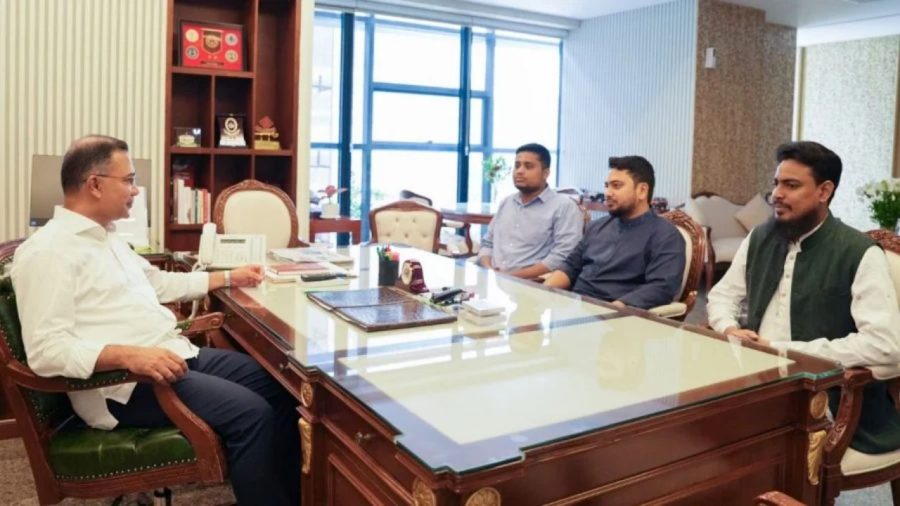
The NCP delegation at the meeting included Convener Md Nahid Islam, Senior Joint Convener Hasnat Abdullah, Joint Convener Akram Hossain and another party representative.