



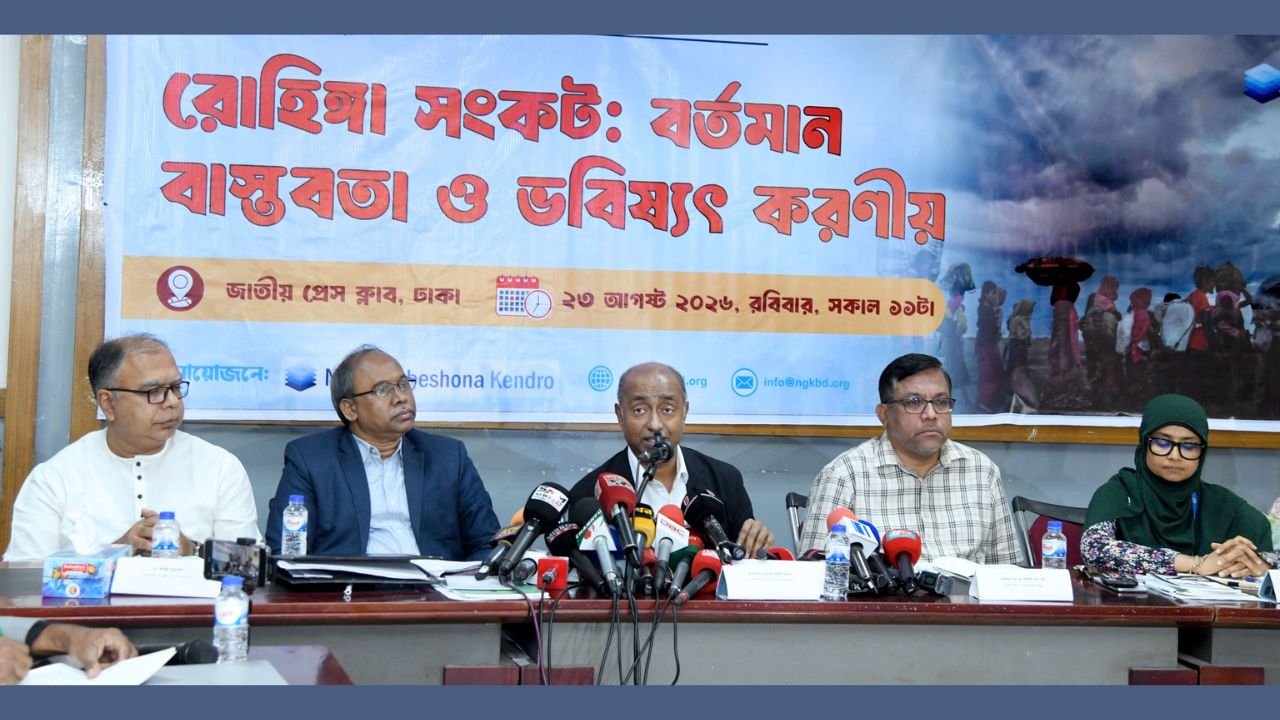



Law, Justice and Parliamentary Affairs Minister Md Asaduzzaman on Sunday said co-operation from the international community is key to a permanent solution to the Rohingya crisis. At the same time, building a national consensus is also urgent to address the issue.
Asaduzzaman made these remarks on Sunday noon while speaking as the chief guest at a discussion titled “Rohingya Crisis: Current Reality and Future Way Forward,” organised by the Policy Research Centre at the National Press Club in Dhaka.
He said the Rohingya crisis should not be viewed solely from a security perspective; rather, it involves humanitarian, social, diplomatic, and international legal dimensions. Along with safeguarding Bangladesh’s security and stability, ensuring the humanitarian and fundamental rights of the Rohingyas is highly important.
The minister noted that the Rohingyas took shelter in Bangladesh after facing persecution and human rights violations in their home country, and Bangladesh has stood by them out of humanitarian values and responsibility.

He emphasised that ensuring the life, security, and basic rights of the Rohingya people is urgent.
Asaduzzaman underscored the necessity of ensuring a conducive environment for the safe, dignified, and sustainable repatriation of the Rohingyas to their homeland. To achieve this, effective co-operation and coordinated efforts from the international community are vital.


He further said the Rohingya crisis must be tackled in light of Articles 21 and 25 of the Constitution of Bangladesh, keeping in mind citizens’ duties to the state alongside international peace, security, and mutual relations between countries.
At the same time, criminal activities and other security-related challenges in the Rohingya camps must be properly addressed.
Alongside diplomatic efforts and negotiations with the international community, building a strong public opinion within the country is essential to confront the crisis, Asaduzzaman added. He urged researchers, experts, civil society, and the media to play a constructive role in this regard.
He invited the Policy Research Centre and related experts to put forward effective recommendations by considering the social, humanitarian, diplomatic, and international legal dimensions of the crisis, expressing hope that these recommendations would significantly assist government policymaking.
He reiterated that Bangladesh’s ultimate expectation is to ensure the human rights of the Rohingyas and their safe, dignified repatriation to their homeland, which requires national consensus along with international co-operation.
The discussion was also addressed by Policy Research Centre Executive Director Shafiqul Ahmed, former Bangladeshi ambassador to Myanmar Mohammad Sufiur Rahman, Policy Research Centre Trustee Member Professor SK Tawfique M Haque, and Rohingya women’s rights activist Razia Sultana.
The participants exchanged views on the current state of the Rohingya crisis, the humanitarian and social realities of the displaced Rohingyas, the situation in Myanmar, the prospects of repatriation, and the actions required at national, regional, and international levels for a sustainable solution.


