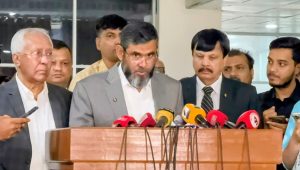

The Bangladesh Judicial Service Association has issued a stern warning that judges across the country will observe a work stoppage if two key demands, centered on ensuring their security, are not met within 48 hours.
The ultimatum was issued on Friday (14 November) in a statement signed by Association President Md Amirul Islam and Secretary General Muhammad Mazharul Islam.
One of the demands calls for strict action against police personnel allegedly responsible for negligence in ensuring a judge’s security in Rajshahi, as well as for presenting an arrested suspect to the media in an unlawful and unprofessional manner.
If both demands are not fulfilled by Sunday (16 November), judges across the country will commence a “pen-down” strike.

The organisation expressed profound shock at the brutal killing of Tawseef Rahman Suman, son of Rajshahi Metropolitan Sessions Judge Mohammad Abdur Rahman.
Suman was stabbed to death at the judge’s residence, and the judge’s wife, Tasmin Nahar, remains in critical condition. The Association offered prayers for the deceased and conveyed condolences to the grieving family.


Calling the attack “horrific” and “unprecedented,” the Association said the judiciary is “stunned and speechless,” with judges nationwide outraged over the security failures that led to the incident.
The statement noted that the Supreme Court has repeatedly urged the government to strengthen security across all courts, tribunals, premises, judges’ residences, and official vehicles.
Despite these requests, it said, “no visible action” has been taken. Judges, who perform some of the most sensitive and high-risk state duties, “remain exposed to serious danger,” it added, pointing to inadequate housing and transportation at the district level.
Conditions are described as even worse for judges serving in chowki (subordinate) courts, many of whom are forced to live in insecure rented homes and travel by rickshaw, van, or on foot.
Although the judiciary has long spoken out about such “indifference and gross negligence,” the state has taken no effective measures—leading, the Association says, to the current tragedy.
Judges, the statement concluded, work tirelessly to ensure the safety of the state and its people, yet the state has failed to safeguard them. “The responsibility for this bloodshed cannot be avoided,” the Association warned.