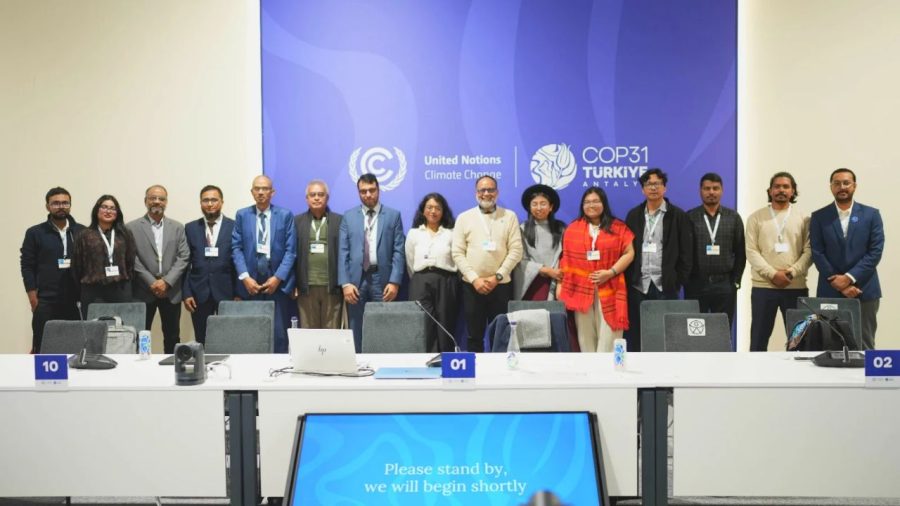



Civil society groups, policymakers and Indigenous leaders at COP31 have called for an immediate shift towards debt-free climate finance, warning that 25 years of loan-dominated funding has left climate vulnerable nations trapped in debt while earth’s ecological boundaries collapse.
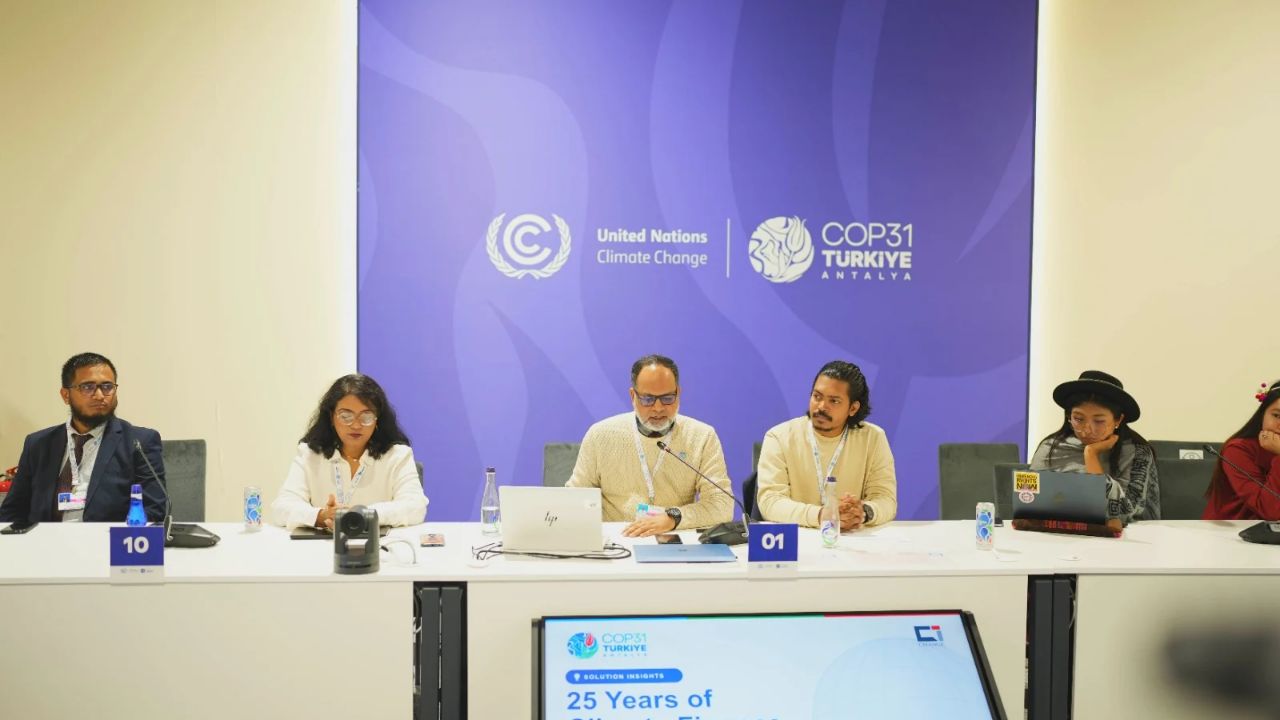
At a policy dialogue titled “25 Years of Climate Finance: Progress, Gaps and Transformative Solutions”, co-organised by Change Initiative and Young Power in Social Action (YPSA) on Youth Day, speakers presented a critical assessment of climate finance. Analysis showed 69 per cent of public climate finance to developing nations in 2022 arrived as loans, reads a press release.
Over the same quarter-century, seven of nine planetary boundaries have been breached all at record levels,while international biodiversity finance receives only a sixth of funds allocated to climate action.
The Copenhagen target of $100 bn annually by 2020 was reached only in 2022, two years late and primarily through loans. A decade after Paris, national climate plans project emissions cuts of just 11 to 15 percent by 2035, far short of the 45 percent required for 1.5°C. Meanwhile, international public adaptation finance fell from $28 bn in 2022 to $26 bn in 2023, with 58 percent delivered as loans.

Najifa Alam Torsa, junior research analyst at Change Initiative, said countries facing climate damage are taking on repayments while trying to protect their people. M Zakir Hossain Khan, co-founder and chief executive of Change Initiative, who chaired the dialogue, emphasised that money is not the issue, but rather that developed countries lack interest in providing grants, calling the current system “debt by design”.
Data from Change Initiative’s Climate Debt Risk Index shows 47 of 55 climate-vulnerable countries face high or very high climate-debt risk. Bangladesh ranks in the high-risk category with a score of 65.37, carrying roughly $80 of climate debt per person. Between 2002 and 2023, 92 percent of the $2.54 bn in energy-sector climate finance received by Bangladesh came as loans, while 18.84 percent went to fossil-fuel projects. Biodiversity finance stood at $18.9 bn in 2024, compared with $115.9 bn for climate in 2022, despite nature absorbing half of human carbon emissions.


Mofazzal Hossain, research coordinator at Change Initiative, put four questions to negotiators, whether current finance can restore breached boundaries, what climate action achieves without restoring biodiversity, what the $300 bn target accomplishes without a debt-free pathway, and whether treating climate separately aligns with Earth-system science. He said investing while destroying ecosystems makes no sense.
Change Initiative identified 12 debt-free sources capable of raising $35 bn to $400 bn annually by the early 2030s, including fossil fuel profit levies ($60 bn in a medium scenario), a 2 percent billionaire tax, a 1 percent defence contribution ($29 bn), and levies on aviation, shipping, plastics, financial transactions, crypto mining and AI data centres.
Barrister Mahbubul Alam Salehin, member of parliament for Kurigram-3 and member of Bangladesh’s parliamentary standing committee on environment, forest and climate change, highlighted char families displaced up to 20 times. He said Bangladesh must not become poorer while protecting itself, setting out five priorities, a collective grant-first package with a delivery timetable, debt relief, an energy transition serving economic security, natural rights via a Living River Resilience Delta Initiative, and negotiating accountability.
Muhammad Haseeb Khan, project lead for West and South Asia at the Climate Vulnerable Forum and V20 Secretariat, representing 77 vulnerable economies, noted vulnerable countries borrow at 15 to 18 percent interest versus 2 to 3 percent for rich nations. Calling the system failed, he noted short-term loans fund 40-year infrastructure like schools, urging support for the V20’s Vulnerability to Viability Compact with the OPEC Fund and 16 development finance institutions.
Dr Fazle Rabbi Sadeque Ahmed, Bangladesh’s lead negotiator on climate finance, noted the lack of an agreed definition for climate finance and reported that the Adaptation Fund received only $300 mn of its requested $400 mn for 160 countries this year. He called for new, additional and grant-based climate finance without market-based loans, cautioning against applying “carbon tax” labels to low-emitting countries.

Indigenous representatives demanded direct grant access. Mithun Toppo of the Maleya Foundation, secretariat of the Bangladesh Indigenous Peoples’ Network on Climate Change and Biodiversity, called for a grant mechanism respecting free, prior and informed consent that includes Indigenous peoples beyond the Chittagong Hill Tracts in the National Adaptation Plan.
Wara Ruiz, an Aymara representative from Bolivia representing the International Indigenous Peoples’ Forum on Climate Change, said 25 years is a lifetime and communities cannot wait any longer. Md Shahjahan of Climate Action Network South Asia (CANSA) Bangladesh added climate finance must come from government budgets as grants.
The Change Initiative proposed a unified finance architecture treating climate, biodiversity and water as one Earth system. Its five pillars comprise polluter-pays mechanisms like a Climate Damages Tax, a 1 percent defence budget contribution, redirecting fossil fuel producer support, levies on private jets, shipping and carbon border revenues, and reserving 30 to 40 percent of new levies as grants for least developed countries and small island developing states. Mr Khan concluded that success must be measured by restoring earth boundaries restored, stressing a burning planet cannot be left to future generations.