





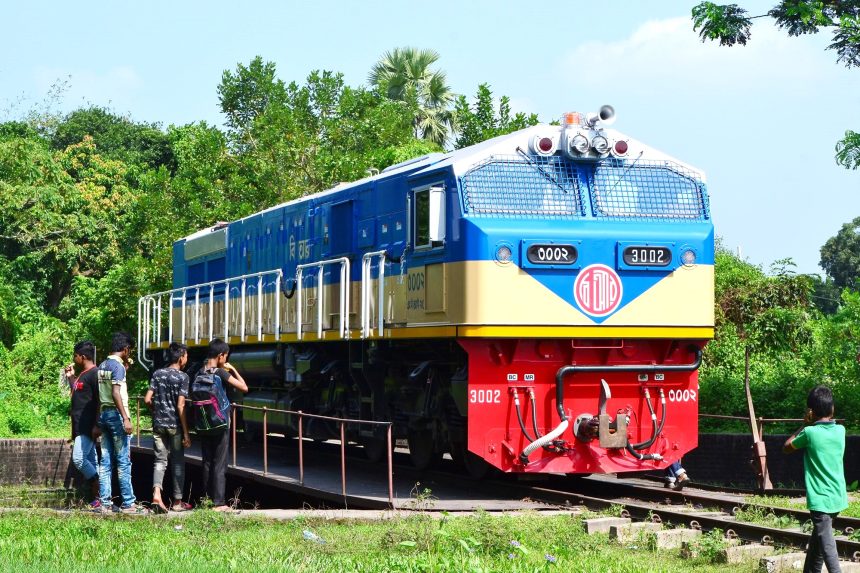
Bangladesh Railway (BR), long valued for its affordable and comfortable long-distance travel, is grappling with more than Tk 1,400 crore in losses for the 2023–24 fiscal year, raising fresh concerns over its financial and operational efficiency.
Railway sources said around 350 trains, including intercity, local, and freight services, run daily across the country, carrying 80 to 90 million passengers every year. Yet the BR continues to struggle with outdated systems, poor revenue collection, and a lack of modernisation, reports UNB.
Passenger services, the primary focus of railway operations, generate most of its income. But experts argue that limited investment in freight transport — which is generally more profitable — is holding back the organisation’s financial potential.
At Dhaka’s Kamalapur Railway Station, Masud, a businessman from Brahmanbaria, described trains as more comfortable than buses for long journeys, but complained of ticket shortages and frequent delays.
Railway officials, speaking on condition of anonymity, said tickets are effectively subsidised by 40–50 percent, as fares have not changed since 2016 despite repeated fuel price hikes. Combined with rising operational expenses and pay-scale adjustments since 2015, this has placed significant strain on the agency’s finances.
Staff shortages are also a major concern. Of 47,000 approved posts, only about 23,000 are currently filled. Officials said this shortfall limits service quality and prevents the expansion of routes that could bring in more passengers and revenue.
Popular routes such as Dhaka–Chattogram and Dhaka–Khulna via the Padma Bridge could see additional trains in the future to meet rising demand, but this would further increase maintenance costs.
Experts cite poor planning as another key issue. Mohammed Shahid Miah, president of the National Committee to Protect Shipping, Roads and Railways, said train availability is poorly matched with demand. Popular routes like Dhaka–Mymensingh and Dhaka–Jamalpur are underserved, while less-used routes are oversupplied, increasing costs without proportional income.
According to railway officials, retirement benefits are a further burden, with nearly Tk 1,000 crore spent in the 2024–25 fiscal year alone, paid directly from operational budgets rather than a separate welfare fund, unlike other government departments.
Railway revenue was Tk 1,925 crore in 2023–24 but fell to around Tk 1,800 crore in 2024–25 after weeks of disruption during last year’s anti-discrimination movement.
Bangladesh Railway Director General Afzal Hossain acknowledged the challenges, noting that unchanged fares and rising maintenance costs make subsidies unavoidable. He said freight remains a profitable sector but has declined in recent years.
“As a service-oriented institution, our priority is to serve the public interest with convenient and comfortable journeys, rather than profit alone,” he added.
Transport analysts say Bangladesh Railway could take lessons from countries such as India, China, and those in Europe, which have boosted rail revenues by expanding freight operations. They argue that long-term planning and investment are crucial if Bangladesh Railway is to become a financially sustainable, efficient, and modern transport provider.


