


Green growth must be placed at the centre of Bangladesh’s development strategy to strengthen energy security, maintain macroeconomic stability and sustain competitiveness in international markets, speakers said at a policy dialogue in Dhaka on Tuesday.
They stressed the need for investment in renewable energy, affordable financing, technological innovation and effective policy implementation to achieve these goals.
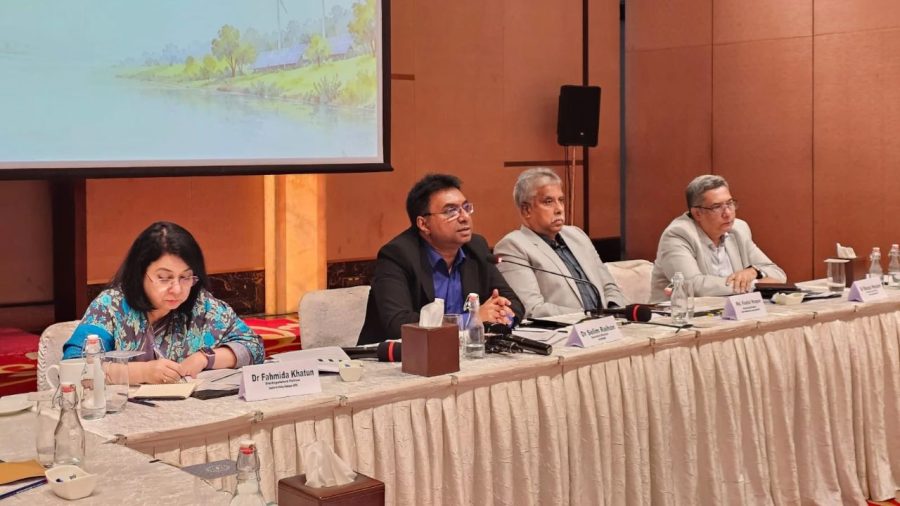
The dialogue, titled “Can Green Growth Drive Bangladesh’s Next Phase of Development?”, was organised by the South Asian Network on Economic Modeling (SANEM) at Hotel Sheraton in the capital on Tuesday.
SANEM Executive Director and Dhaka University Professor of Economics Selim Raihan said reducing dependence on fossil fuels and addressing limitations in the renewable energy supply system were important for Bangladesh.
He said the country’s development priorities needed to be aligned with its international climate commitments. Policy consistency, sector-specific targets and effective implementation mechanisms were also necessary to achieve green growth.
Raihan said efficient energy use and the transition to cleaner energy could help boost economic growth and household consumption. However, he stressed that the benefits of the transition must reach people across different sections of society.

Fahmida Khatun, distinguished fellow at the Centre for Policy Dialogue (CPD), said inclusive development and a just energy transition were essential.
She noted that a large share of international climate finance remained focused on mitigation rather than adaptation. According to her, around 65 per cent of international climate finance was allocated to mitigation activities, while 35 per cent went to adaptation.
Fahmida stressed the need to increase adaptation financing to address the impacts of climate change and strengthen financial and technical assistance from international sources. She also highlighted the importance of building the capacity to use these resources effectively.
Manzur Hossain, member (secretary) of the General Economics Division of the Bangladesh Planning Commission, expressed optimism about achieving the target of generating 20 per cent of the country’s electricity from renewable sources by 2030.




According to him, reaching the target would require around 6,000 megawatts of renewable power generation capacity.
He highlighted the potential for rooftop solar power and stressed the need for accessible green financing, training and skills development for micro, small and medium-sized entrepreneurs.
Hasan Mahmud, director (innovation) of the Bangladesh Energy and Power Research Council (BEPRC), underscored the importance of energy efficiency, energy conservation and domestic technological innovation.
Mohammad Fazlul Hoque, administrator of the Federation of Bangladesh Chambers of Commerce and Industry (FBCCI), said the cost of alternative energy sources, their availability and the scope for expanding production capacity needed to be considered when determining energy options.
Although interest in solar power is growing, he said, land constraints remained a major challenge.
Referring to the failure to establish a central effluent treatment plant for the leather industry over the past two decades, he also highlighted weaknesses in policy implementation.
AHM Shafiquzzaman, president of the Consumers Association of Bangladesh (CAB), said the initial investment required for rooftop solar installations was high.
Under a capital expenditure-based model, installing a one-megawatt solar power system could cost around Tk6 crore to Tk8 crore, he said.
He stressed that the challenges involved were not limited to installation costs and that financing and operational difficulties also needed to be addressed.
Asif Ibrahim, vice-chairman of New Age Group, said rooftop solar installations could reduce energy costs for businesses. However, high upfront investment, limited financing opportunities, tax-related barriers and weak policy enforcement were hindering wider adoption.
Meheruna I Chowdhury, project economist at the United Nations Development Programme (UNDP) in Bangladesh, said green growth was directly linked to competitiveness in international trade.
She said Bangladeshi businesses needed to prepare to meet changing environmental requirements in global markets, including the European Union’s Carbon Border Adjustment Mechanism (CBAM).
The dialogue also discussed the quality of solar panels and inverters, barriers to net metering, solar-powered irrigation and the integration of renewable energy into the national electricity grid.
Speakers further emphasised the need to improve access to climate finance, raise public awareness, provide technical assistance and ensure effective implementation of renewable energy policies.
They noted that these initiatives had become even more important in the context of Bangladesh’s graduation from the least developed country (LDC) category.
In his concluding remarks, Selim Raihan said a broader industrial policy framework is needed to encourage investment in green sectors.
He also stressed the need to make it easier for new businesses to overcome institutional and bureaucratic barriers.